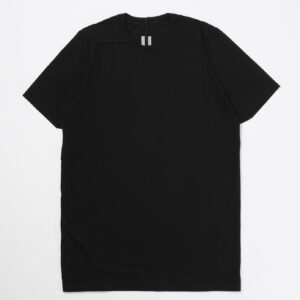
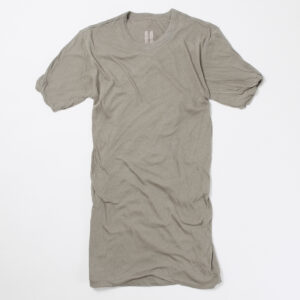
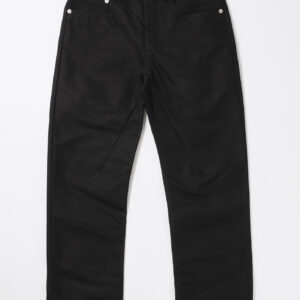
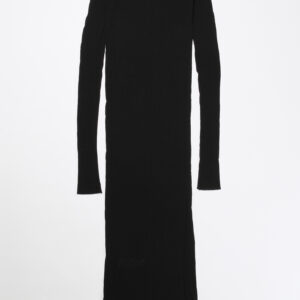
Rick Owens was born in Porterville, California, in 1961, and grew up without television until he was sixteen. What he had instead was opera. His account of that childhood is that “my youth was filled with exotic stories of La Traviata, Norma, Aida… stories of longing, sacrifice, ecstasy, and death that I believed forming me.” It is a better key to the work than most of the vocabulary attached to it. Opera deals in longing and death at a scale built to be read from the back of a hall, and that is a cutting problem long before it is a mood.
He studied art at Otis for two years and then went to Los Angeles Trade-Technical College to learn pattern-making and draping. The order matters. He learned to cut before he learned to design, and the house has been a cutting argument ever since: where a seam sits, how much cloth is held away from the body, what happens to a sleeve if you let it run past the wrist.
The label began in Los Angeles in 1994, out of a shop on Hollywood Boulevard. He showed in New York in 2002 with Vogue’s backing and took the Perry Ellis Award for emerging talent the same year. In 2003 he and Michèle Lamy moved to Paris and put the house, the studio, and everything else into one building on the Place du Palais Bourbon. Lamy is a co-founding partner of Owenscorp, formed the year after, and runs its art and furniture side. She is a principal of this house rather than a presence around it.
The clothes are made in Italy, and nearly all of them come out of one town near Modena, Concordia sulla Secchia, where Owens has worked with the same producers since the early 2000s and where the house makes the great majority of what it sells. That is an unusually settled arrangement, and it is why the construction stays consistent from one collection to the next in a house whose silhouettes do not.
Venice is the other place. He keeps a house on the Lido, the long sandbar that closes the lagoon off from the Adriatic, and he describes it this way: “The Lido is ten minutes away from the Grand Canal but a world apart. It has the modesty and serenity of a small village ignored by the crowds flocking to Piazza San Marco.” Seeing Visconti’s Death in Venice in a California movie theater in his teens, with Mahler underneath it, is one of the few origin stories he tells about himself, and the Lido is where that film strands its composer. It explains more about the work than Los Angeles does.
What the clothes look like is well known and usually described badly. It is drape rather than tailoring, asymmetry as a structural decision rather than a flourish, and a palette worked almost entirely in black, dust, and pale natural tones, with the house’s own color names attached to them. It is also, and this is the half that gets lost, extremely wearable. Beside the leather and the long coats sit jersey, knitwear, and trousers that people put on every day of the week. His own formulation covers both halves at once: “My aesthetic goal has always been to drag a bit of radical fantasy into everyday living… which always ends up looking a bit alien.” The everyday living is not the throwaway part of that sentence, and neither is the alien. The severity is what makes the plain pieces worth owning, and the plain pieces are what stop the severity from reading as costume.
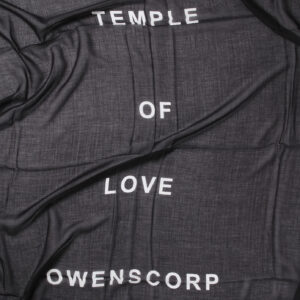
The house has grown sideways rather than upward. DRKSHDW, begun in 2005, is the jersey and denim side of it. Lilies is the womenswear line beside the main one. Furniture arrived in 2005 as well and has been shown at the Musée d’Art Moderne in Paris and at MOCA in Los Angeles. The CFDA gave Owens the Geoffrey Beene Lifetime Achievement Award in 2017, the same year the Triennale di Milano opened Subhuman Inhuman Superhuman, his first museum retrospective. In 2025 the Palais Galliera gave him Temple of Love, the first exhibition in Paris devoted to his work, with more than a hundred garments, brutalist sculpture and Californian planting out in the garden, and Owens working on it himself as artistic director.
Two things are worth knowing before you look, because they confuse people in this house more than in most.
The first is the naming. Owens names a garment with the Italian noun for what it is. Abito is a dress, Giacca a jacket, Maglia a knit, Camicia a shirt, Pantaloni trousers. Model names sit on top of those and are his own: Geth, Level, Hollywood, Heizer, Fogpocket. A model name tells you the pattern. It tells you nothing about the cloth.
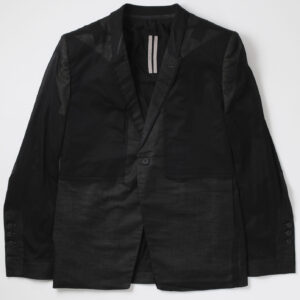
The second follows from the first. He recuts a model across cloths and weights, so two garments sharing a name are frequently not versions of one another. Hollywood exists as a jacket in cupro, as a jacket in a wool and cupro blend, and as a jacket in lamb leather. Geth is a denim name and has been put on a pressed trouser with welt pockets, which is the joke and the point at once. Read the composition line, not the name.
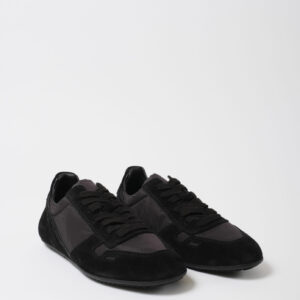
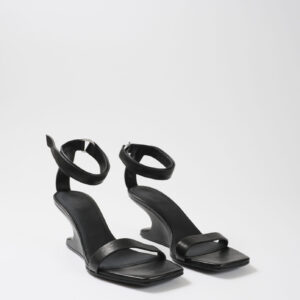
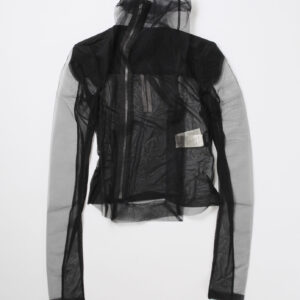
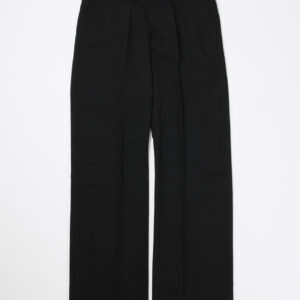
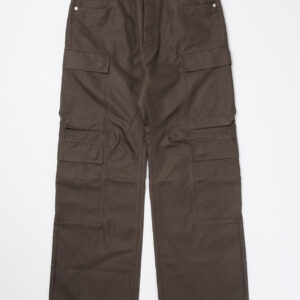
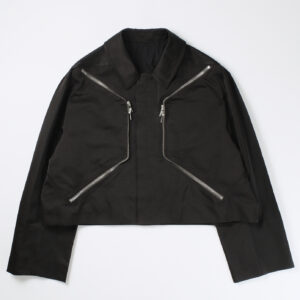
What we have taken runs across the house rather than gathering in one corner of it. Tailoring, where the pressed crease and the volume argue with each other and neither wins. Leather, which is where the off-center closures and the spine seams live. Jersey, which is the everyday half of the house and the part that gets worn out. Knitwear, footwear, scarves, and dresses. If you want one place to start, start with a trouser.
Owens cuts long. Hems are drawn to stack over the shoe rather than to break at it, and sleeves are drawn past the wrist. That is a proportion decision and not a sizing error, and it is worth knowing before you size down to correct it. If you are between sizes, call us and we will measure it before you commit.
Tailoring, leather, jersey, knitwear, footwear, and accessories.