Lavenham began in 1969, in Suffolk, with a horse. Mrs Elliot had looked at the rugs available to cover one and found them wanting: wool, slow to dry, quick to perish, and no match for an English winter that would not stop being wet. What she made instead was the world’s first nylon quilted horse rug, and the company that grew out of it took its name from the village it was made in.
The clothing followed from the rug. A quilted gilet came next and became the signature, and it has stayed the signature ever since. That order of events explains more about a Lavenham garment than any design statement would. This is country outerwear descended from equipment, drawn up to solve a weather problem before anyone asked it to solve a wardrobe one, and the quilting on it is structural rather than decorative because that is what it was for in the first place.
The making has never left Suffolk. The factory stands six miles from the site of the original one in Lavenham village and employs more than a hundred skilled people, and the whole sequence happens under that roof. In the house’s own words: “All our fabric is quilted in house on one of our five quilting machines. The fabric is then cut into pattern pieces before making its way to the finishing floor where it is sewn into the final garment.” That is a short sentence for a long process, and it is short because the house owns every step of it.
The materials are the house’s own too. Lavenster is its proprietary polyester, hard-wearing by design and now spun from recycled bottles, and the wadding behind it is partly recycled as well, chosen to hold warmth without adding weight. Alongside it Lavenham buys traditional workwear cloth from British mills. Nicholas Daley, whose own work runs on British and Japanese cloth, has collaborated with the house repeatedly across three seasons, describing it on his own pages simply as the British quilting specialists. That is roughly how the trade regards it: not a name to borrow, a capability to use.
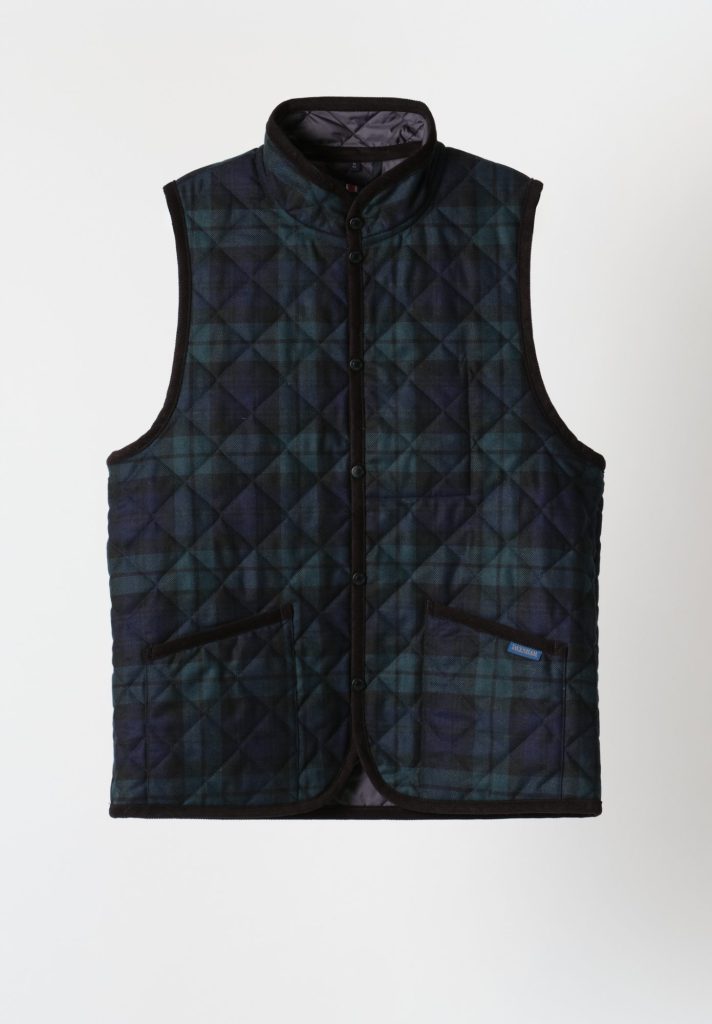
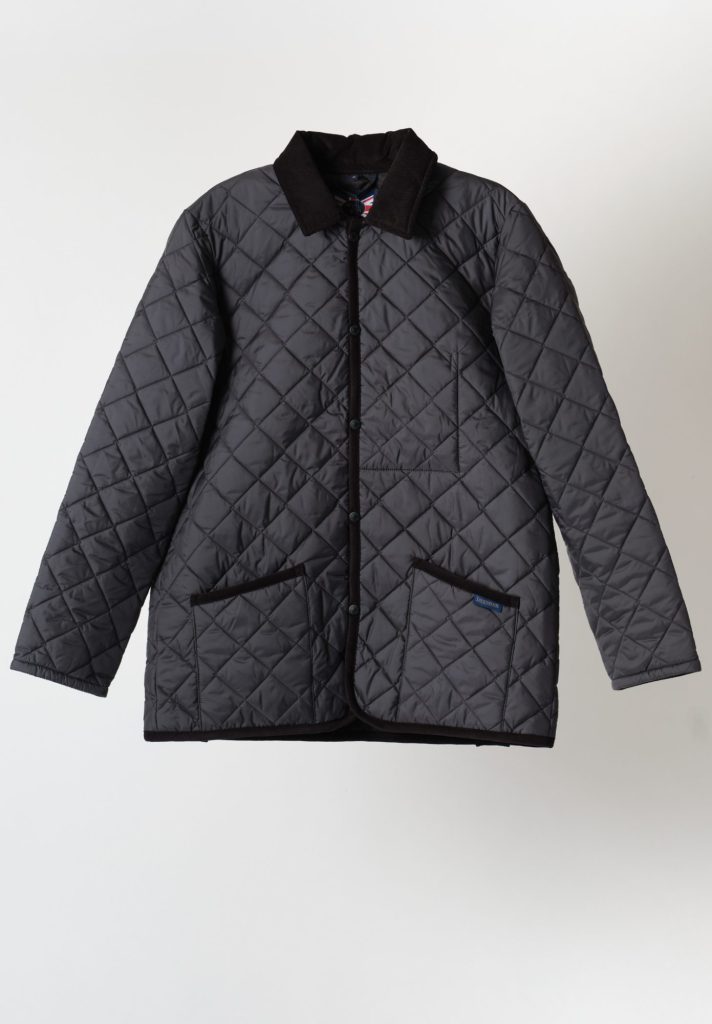
The Lavenham pieces at W Department are the Blackwatch Mickfield gilet and the Denham jacket, and between them they show the house arguing with itself in a useful way.
The Mickfield is the older idea. It is the sleeveless quilted body the house has been making since the beginning, cut in a two-inch diamond quilt, patch pockets, and a binding of organic cotton corduroy, and its outer is a Blackwatch tartan in Italian wool blended with polyester over a recycled polyester lining. Wool over a quilted body is the traditional answer, and the corduroy binding is the detail that stops it reading as sporting goods.
The Denham is the house answering in its own material. Same two-inch diamond quilt, but outer and lining are both Lavenster, the recycled polyester Lavenham makes for itself, in lamp black. It is cut with a little more room while staying tailored, with two patch pockets, an internal chest pocket, and press studs down the front. One garment is a quilted body dressed in someone else’s cloth; the other is the house all the way through. Both are made in Suffolk.
Quilted in Suffolk, on the house’s own machines, as it has been since 1969.