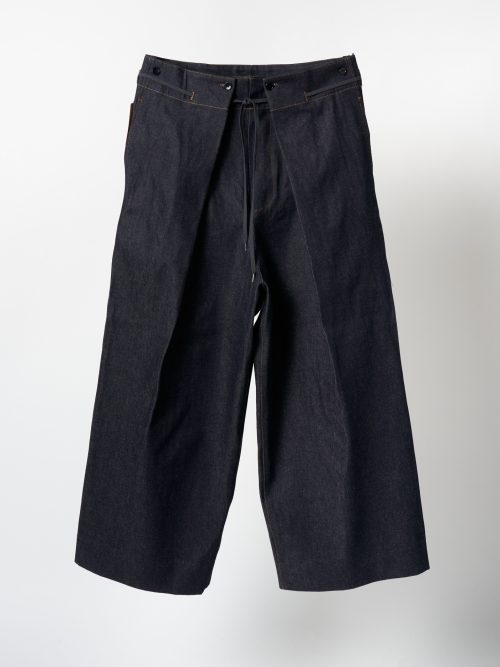
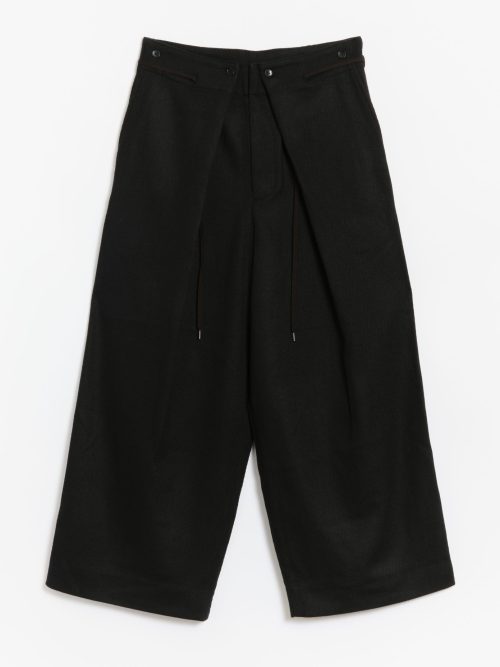
Kuon Hakama Trouser – Olive
$625.00
A hakama is worn over the kimono and has been since the Heian period, and its architecture is pleats. The front is built on deep folds, and they are structural rather than decorative: they hold the shape of a very wide garment, they open as the wearer moves and close again, and the volume they carry is the reason the garment reads as formal rather than as loose. It is held by himo, long ties that wrap the waist and knot at the front, and it usually has a koshiita, a stiffened panel at the small of the back that keeps the whole arrangement upright. Nothing about it is casual. The cloth these are made in is the second half of the idea and it comes from the opposite end of the culture. It is a recycled wool, and a composition of six fibers that ends in one percent acrylic and one percent rayon is the signature of one. Mechanical wool recycling works by sorting old garments by color, shredding them back to loose fiber, and spinning the fiber again, and whatever else was in the original garments comes through into the new yarn. The one percent of acrylic and the one percent of rayon are not specified. They are what the sorting brought with it. And the sorting is done by color for a reason: recycled wool is largely not re-dyed, so the color has to be right before the fiber is ever spun. That is why this trouser exists in an olive and a black rather than in a range, and it is the most honest fact about it.
Why we selected it
We wanted one trouser in the store that carried a real traditional shape without dressing up as one, and the hakama is the shape most often reduced to a silhouette. This one keeps the volume and does something serious with the cloth as well, which is rarer.
The hakama is the shape Kuon returns to more than any other, and this is the version in wool.
The colour
Olive is the harder of the two to arrive at in a recycled wool, because a green has to be sorted for rather than mixed toward, and there is far less olive in the world’s discarded wool than there is black. It is a muted, slightly gray green rather than a warm or an army one, and against the black version of the same trouser it reads as the considered choice rather than the safe one.
Materials and construction
Fifty-four percent wool, thirty-four percent polyester, eight percent cashmere, two percent nylon, one percent acrylic, and one percent rayon. Made in Japan. Recycled wool, in a modern cut taken from the traditional hakama. We do not hold a pleat count, a waist fastening, a pocket description, or a lining statement for these, which is less than we hold on the cotton and seersucker hakama, and it is worth asking about before you decide.
Fit notes
Cut wide, in the hakama manner, so these are chosen at the waist and nothing below it is fitted. A recycled wool has a slightly drier and more open hand than a virgin wool of the same weight, because the fibers have been shortened by the shredding, and it holds a shape well for the same reason. Wool of this kind relaxes across a day and recovers with hanging rather than with pressing.
Styling
With the Aizome Sashiko Shirt, where dark navy against olive is the combination that makes the most of both. With the Zip-Up Cotton Shirt in white for the plainest version. Under the Fanage Corduroy Blazer, if you want two olives that are not the same olive, which works better than it sounds because one is a corduroy pile and one is a wool.
Care
Wool governs these and it governs them absolutely. Heat and agitation together felt wool irreversibly, so these do not go in a machine and they do not go in a dryer under any circumstances. Have them cleaned, or sponge and press from the reverse under a cloth at a moderate heat, which also protects the thirty-four percent polyester from glazing. Hang them rather than folding them, and read the storage advice, because a wool trouser is a moth’s first choice. Our care guidance covers wool and the rest.
Related pieces
The Hakama Trouser in black is the same trouser in black, identical across all six fibers, and the Denim Hakama Trousers are the same shape in cotton. Everything we carry from Kuon is listed together.