At the Palais de Tokyo, Rick Owens’s SS27 women’s collection holds elegant stoicism, release, and resistance to intolerance together in a world of rigid forms, weightless tulle, and fountain mist.
Rick Owens’s Spring/Summer 2027 women’s collection takes its title seriously. “Stone” can mean elegant stoicism. It can also mean the stone rolled aside at Christ’s resurrection, a release after sacrifice. And it can mean the stone thrown at someone judged to be different. Owens holds all three meanings together, then asks what it might look like to meet the world with strength and an open heart.
Paisley and I were there at the Palais de Tokyo on a beautiful day in Paris. A long runway crossed the reflecting pool, with fountains rising on either side. They were turned up so high that mist drifted over the crowd and rained down on those of us in the splash zone. The music was loud and dramatic, as always. The show felt ceremonial, but the collection’s force came from its contrasts: structure and movement, severity and sensuality, weight and air.
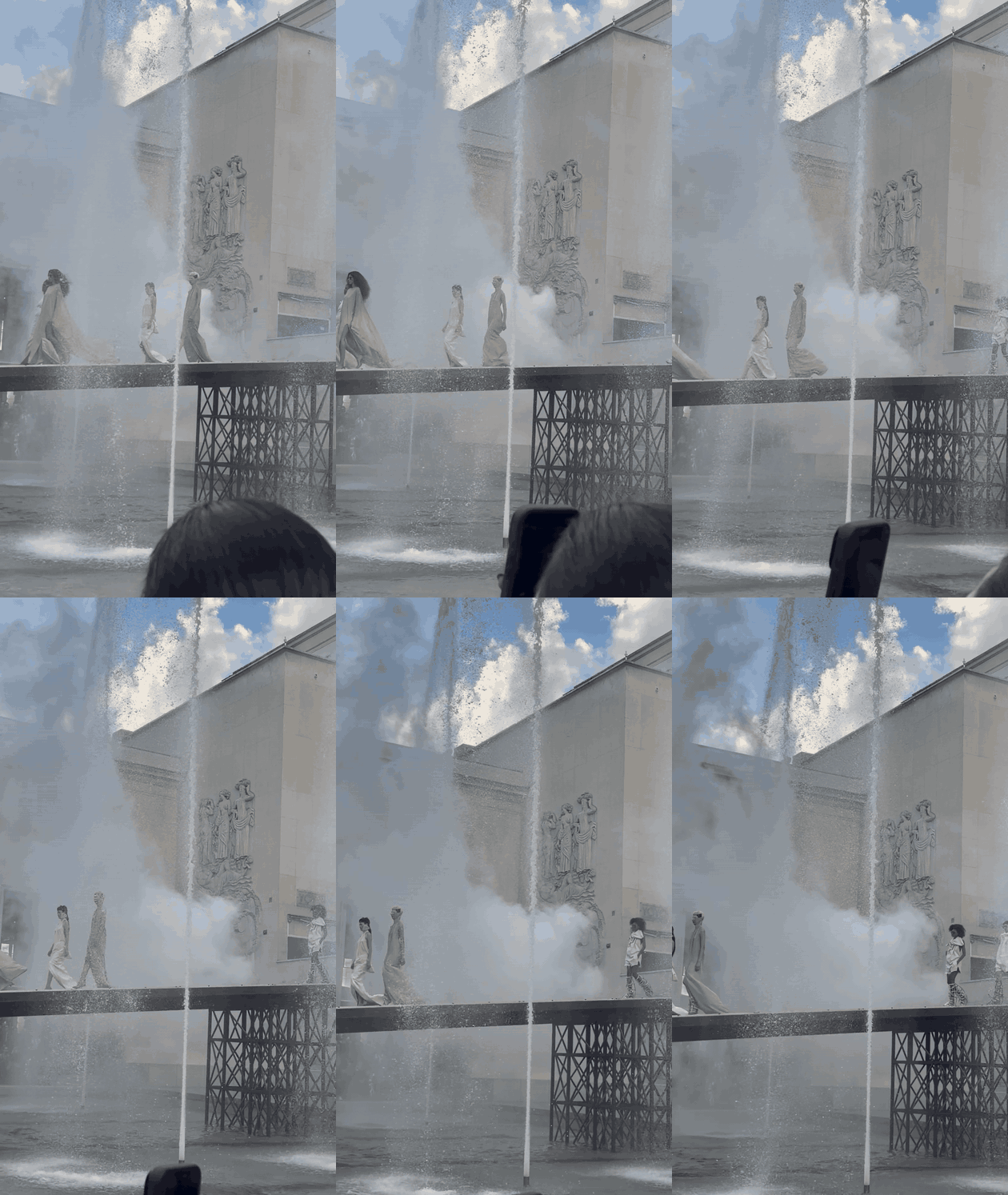
The opening gowns made the collection’s tensions literal. Owens and a supplier in Como transformed industrial nylon webbing, the kind used to secure shipping crates, into a heavy double duchesse. The fabric became a series of rigid slabs crossed by raised, girder-like lines. They had the authority of architecture and the richness of formal dress. Owens describes them as “sumptuous and industrially austere”—a precise account of a collection that finds beauty in opposing conditions.
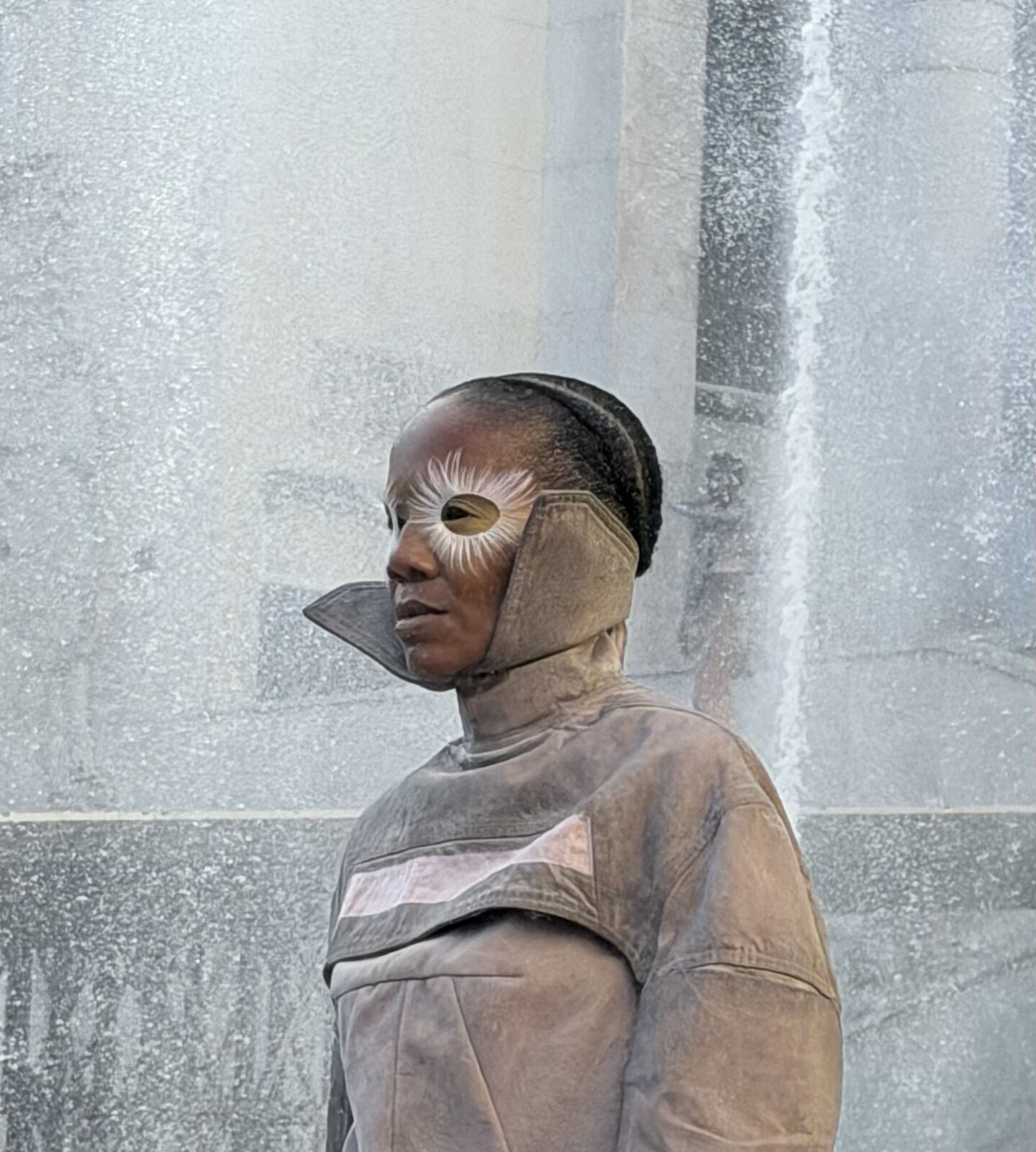
Other gowns used a dense silk duchesse woven in Como, where the slow process produces only about thirty meters of fabric a day. Elsewhere, the collection loosens into flowing pants, tunics, and microjackets in multicolored Japanese denim, bleached in an Italian wash house. Lightweight lamb leather, hand-finished with natural waxes, has a gloss meant to soften and fade with wear.
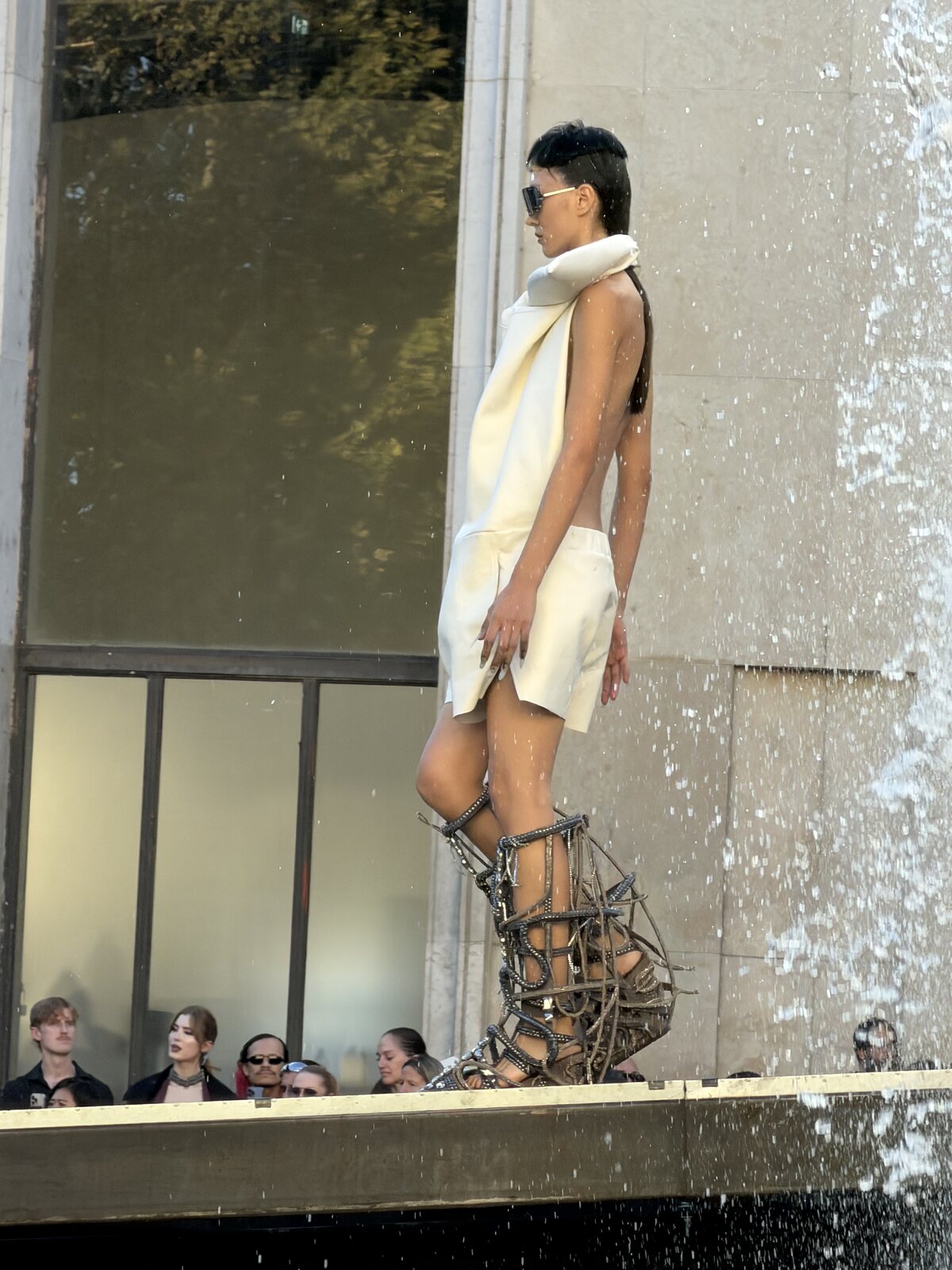
The silhouettes keep returning to the body’s contours. Slouchy skirts have deep pockets and sharp bustles that emphasize the hollow of the lower back. Halter dresses frame the same area with winged collars. The effect is less about conventional prettiness than about making the body’s shape part of the garment’s construction—something revealed, exaggerated, then held in place.
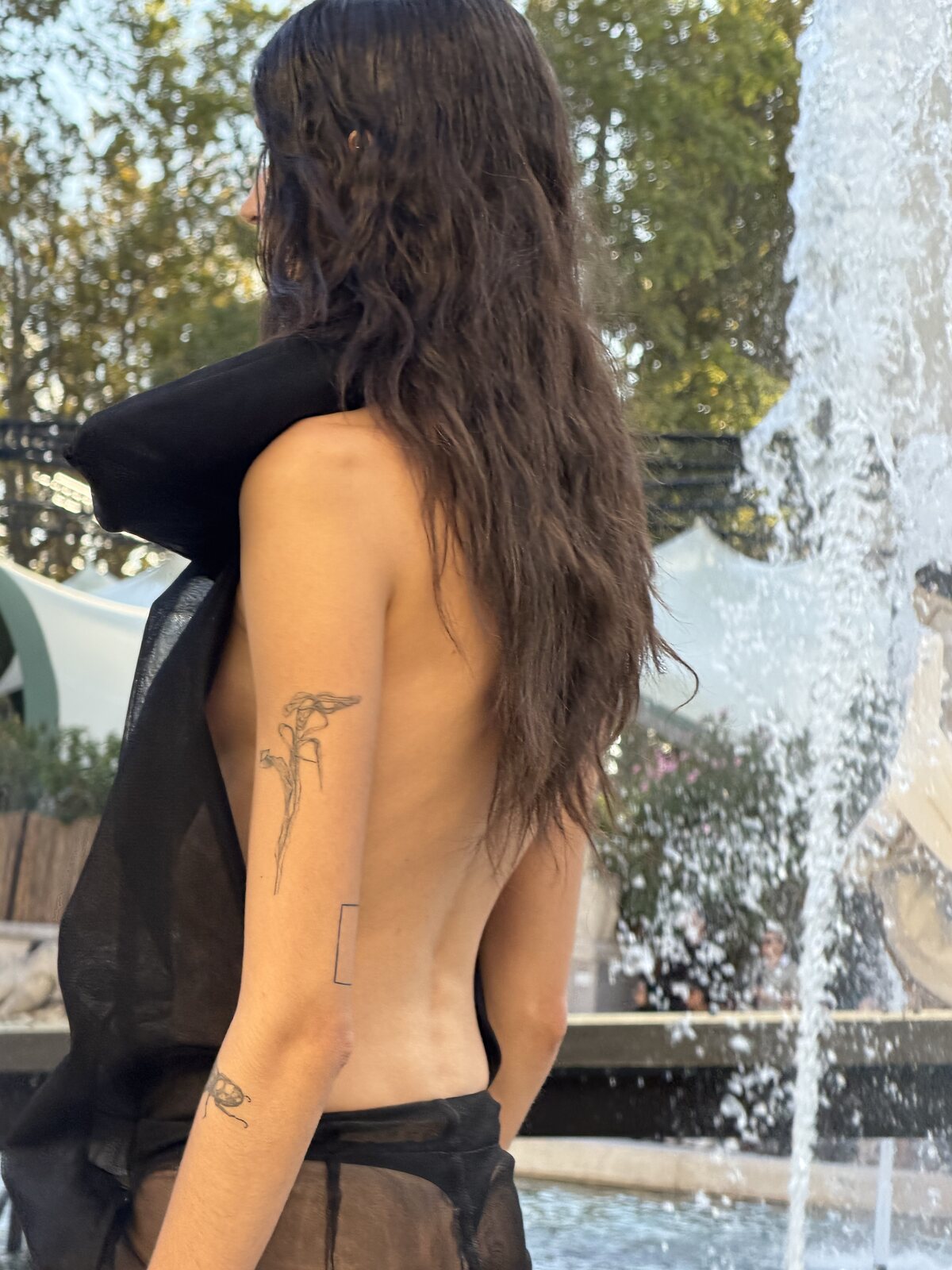
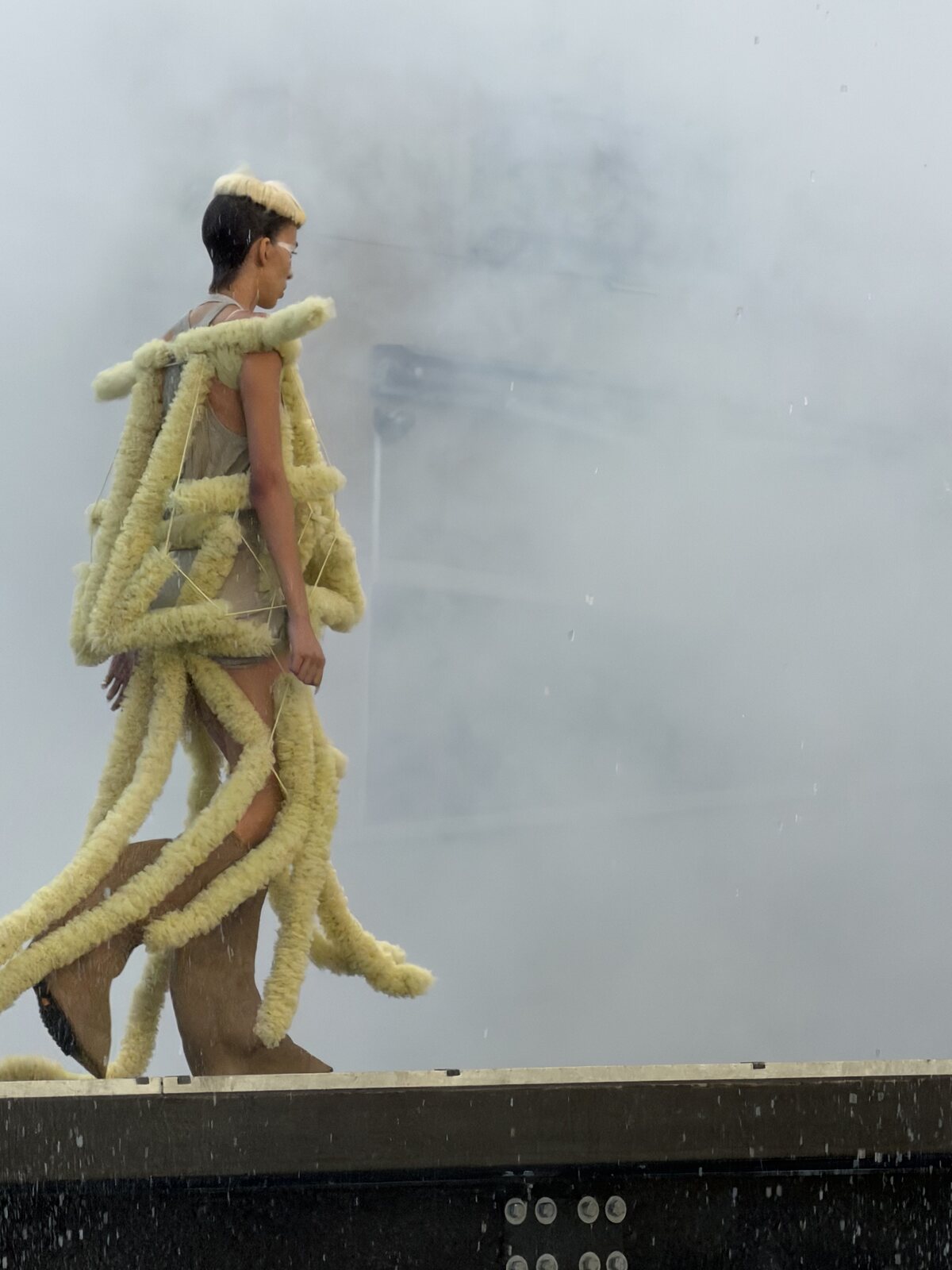
That idea becomes especially clear in the collection’s tensegrity pieces. Owens brought back a construction seen in his previous men’s collection, but changed its material language: what had been rendered in latex and leather now returns as frothy tulle négligées. Tensegrity describes a structure held between compression and tension. In the body, bones compress while connective tissues remain under tension. Here, that structural principle becomes something intimate and strangely delicate. The garments suggest both support and exposure.
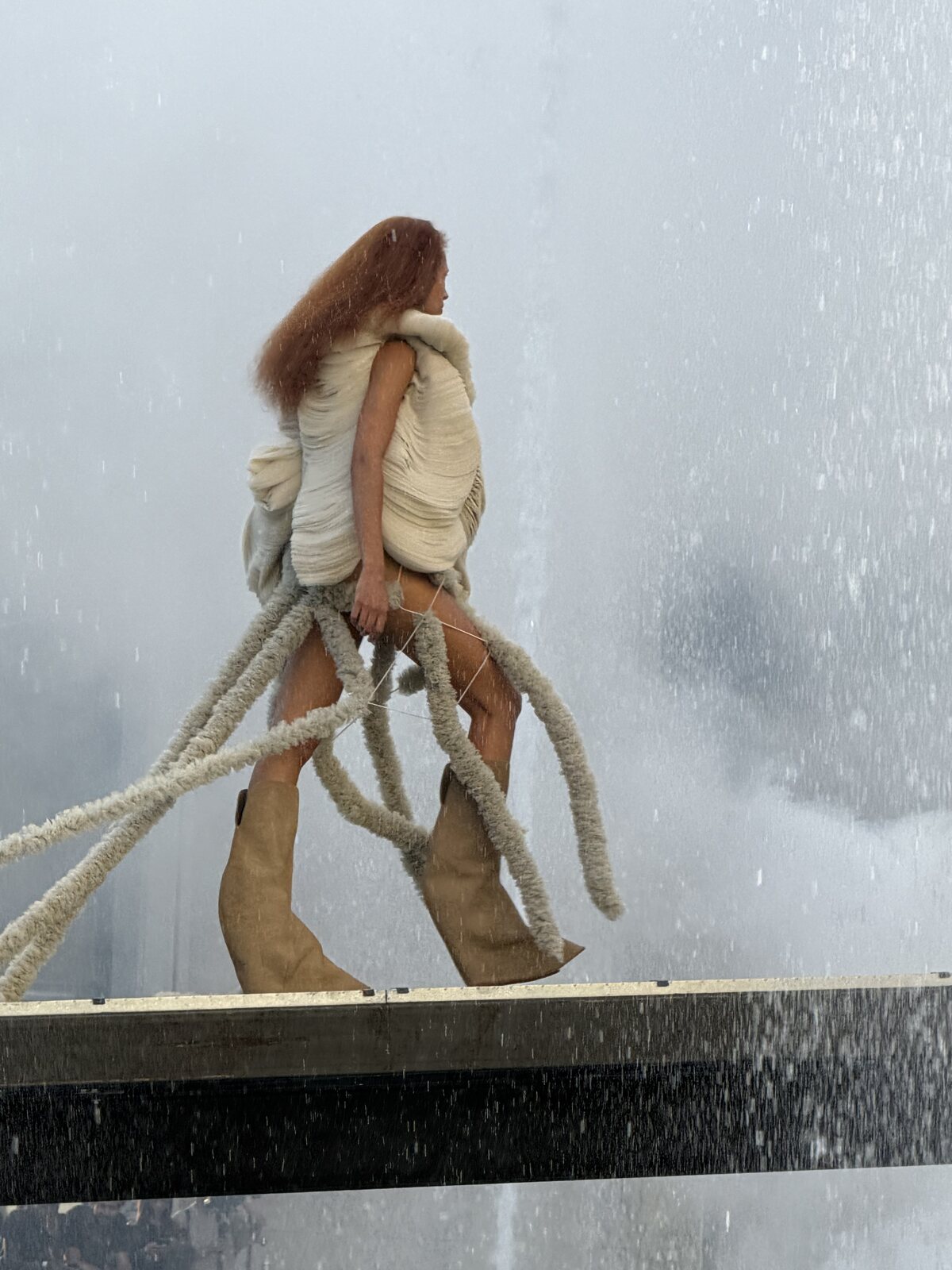
The millefoglie jackets make another kind of structure visible. Thousands of individually cut circles of recycled nylon tulle are sewn onto a base, sculpted to the body, then attached to heavy cotton poplin. Each jacket takes about forty-five hours to complete. From a distance, the effect is airy; up close, it is a record of accumulated labor. The collection repeatedly asks us to look at what holds a form together.
Owens’s pentagrams carry the same tension into the realm of belief. He describes them as a small protest against judgmental condemnation and intolerance: symbols that people have used to demonize what they do not understand, turned here toward openness. In that context, “Stone” is not simply a mood of hardness. It is a question about how to remain composed without becoming closed, and how to build something enduring without using endurance as an excuse for exclusion.
That is where the collection’s materials and ideas meet. The webbing dresses are firm, almost immovable; the silk and tulle invite air. The leather is designed to change with use. The intricate jackets make time and labor visible. None of these gestures resolves the tension completely. They give it shape.
Owens has built a world around the possibility that clothing can hold contradictions without smoothing them away. We saw another version of that tension in his preceding women’s season, Fall/Winter 2026, where elongated bodies, sculptural shoulders, and sweeping coats felt both ceremonial and protective. Read against the previous season’s SS26 “Temple”, where Owens named love as the word he wanted to put into the world, “Stone” feels less like a reversal than a harder test of that openness. This season, he makes that world feel especially considered: a little more exposed, and still committed to the people who exist beyond the boundaries of easy acceptance.
At W Department, Rick Owens’s work is best understood in person: in the weight of a fabric, the line of a shoulder, or the way a silhouette shifts as you move. We carry the collection at 54½ Lincoln Avenue on the Plaza in Santa Fe. We are open daily from 11 a.m. to 5 p.m.