Rei Kawakubo gave denim the royal treatment from the first look. Notes from the Comme des Garçons Spring/Summer 2027 show in Paris, and the gold finale.
Comme des Garçons Spring/Summer 2027, Paris
By now there is little reason to attend a Comme des Garçons show expecting clothes in the conventional sense.
For years Rei Kawakubo has pushed the runway toward sculpture, away from garments that follow the body and toward forms that alter it, obscure it, extend it, and sometimes seem almost independent of it altogether. Her Spring/Summer 2027 collection continued that work. This time she left an unusually legible clue.
“When royal life and everyday life become one.”
That was the single sentence she offered by way of explanation. The show was presented in Paris on October 3 as part of the Spring 2027 ready-to-wear season, although “ready-to-wear” felt like an increasingly inadequate description of what came down the runway.
We arrived at a location near the Eiffel Tower we did not recognize, despite having attended a number of Comme des Garçons shows over the years. The house was full: editors, designers, and many of the familiar figures who circulate through Paris Fashion Week, with Pharrell Williams among them.
The first model emerged alone. Then another.
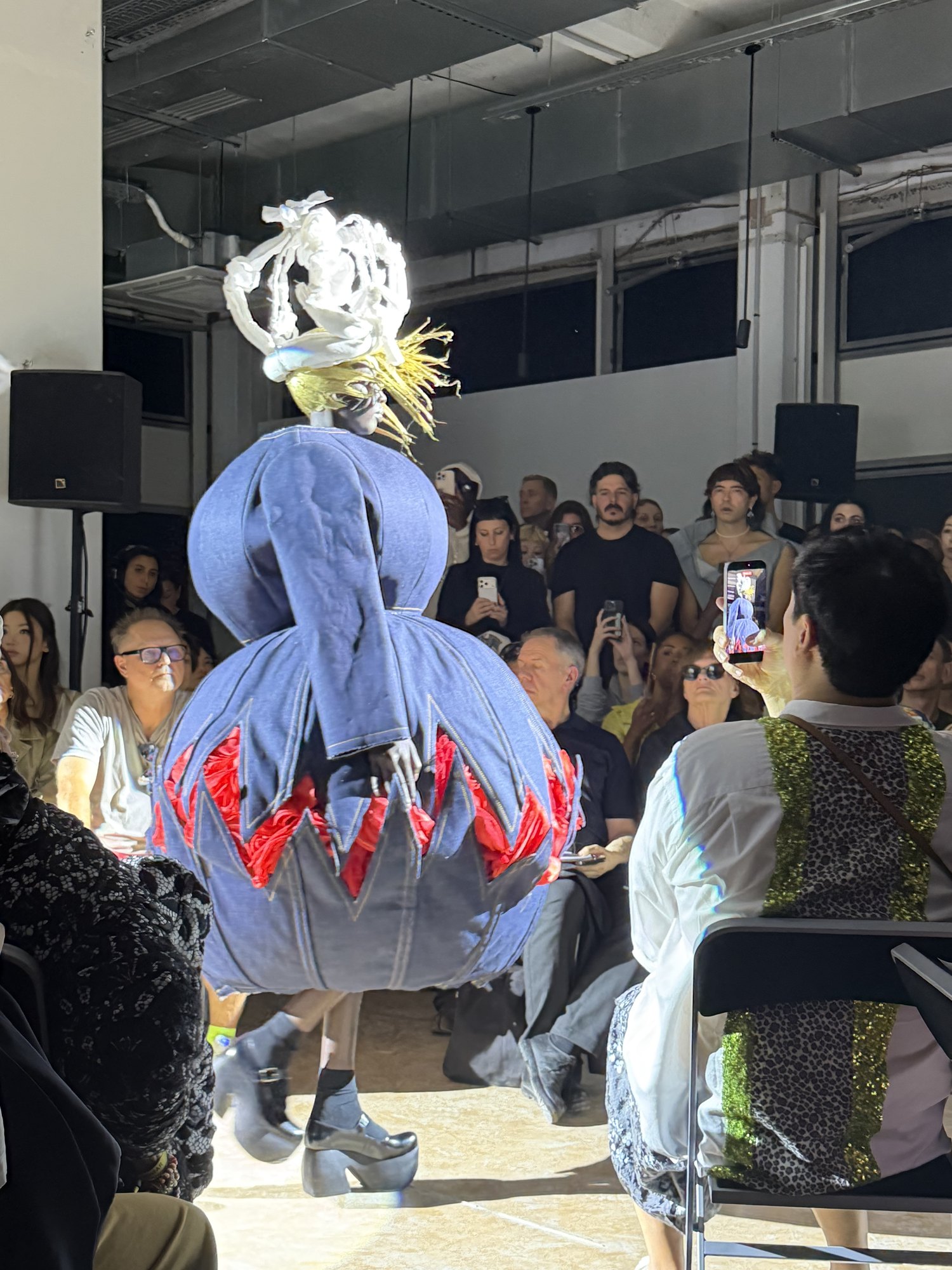
The runway was long and turning, and the models moved through it slowly enough that the progression never became a parade. At some point in each passage, an arriving model would meet another already on her way back.
The returning model would stop. She would stand aside and wait for the approaching figure to pass. Only then would she continue toward the exit.
Sometimes the encounter happened far down the runway. Sometimes it happened almost at the entrance. But it repeated often enough to stop reading as traffic management and start reading as etiquette. A small act of deference. A procession with rules.
Against Kawakubo’s sentence about royal life, it was difficult not to see something court-like in the exchange. One figure approached. Another yielded. There was hierarchy in the movement, or at least the appearance of it.
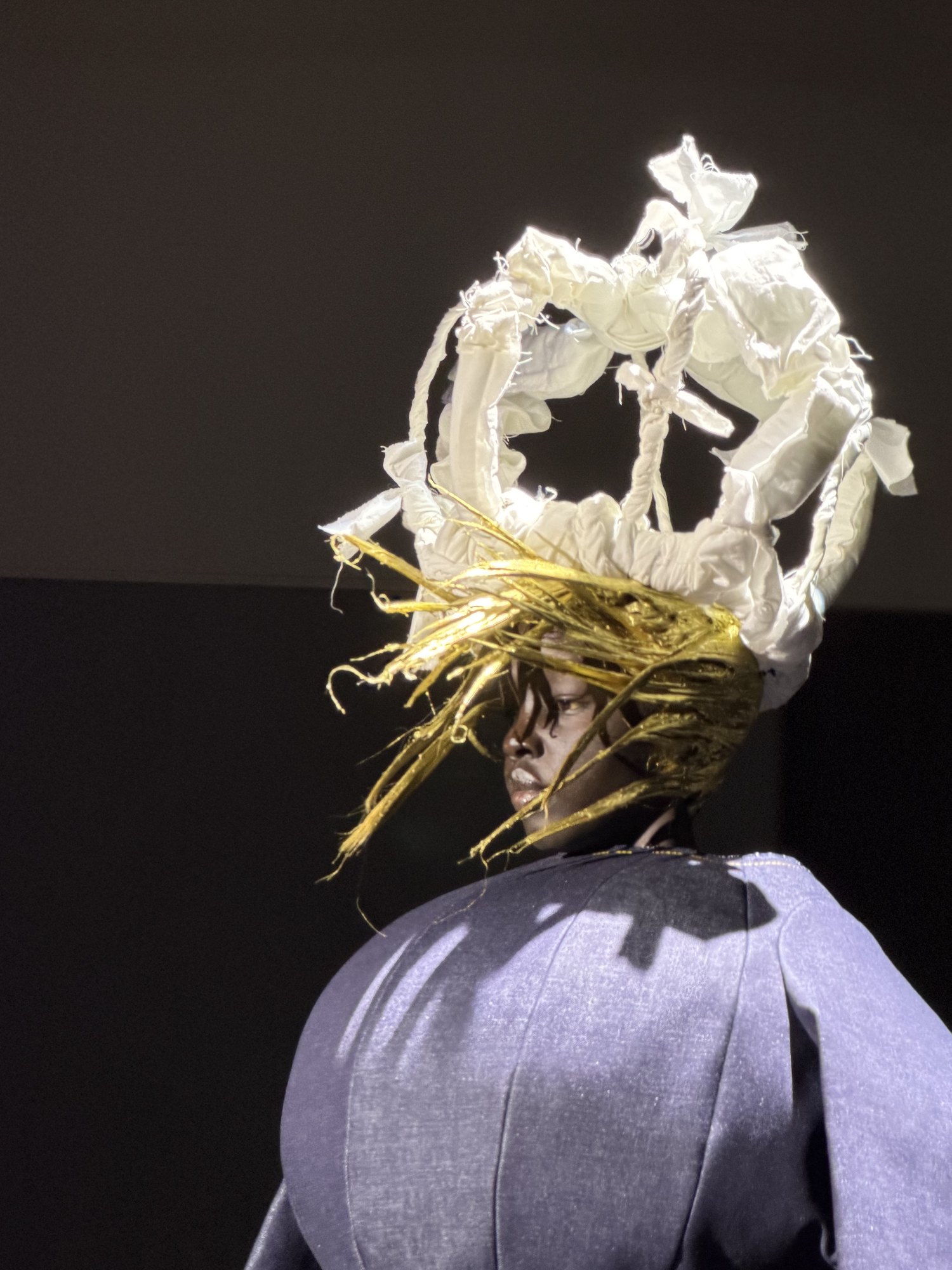
Almost every model carried a structure above the head, swollen abstract forms that suggested a crown without ever becoming a literal one. They were the work of Nobuki Hizume. Some were soft and cloud-like, padded and wired, others tangled or architectural, and their scale turned the head into another part of the silhouette rather than its conclusion.
A collection about royal life might be expected to be built from the materials royalty is dressed in, and brocade and satin are in fact where Kawakubo often begins. Not here. The first look out was raw denim: a jagged, pumpkin-like form with red fabric pushing through the openings, a white padded crown on top of it.
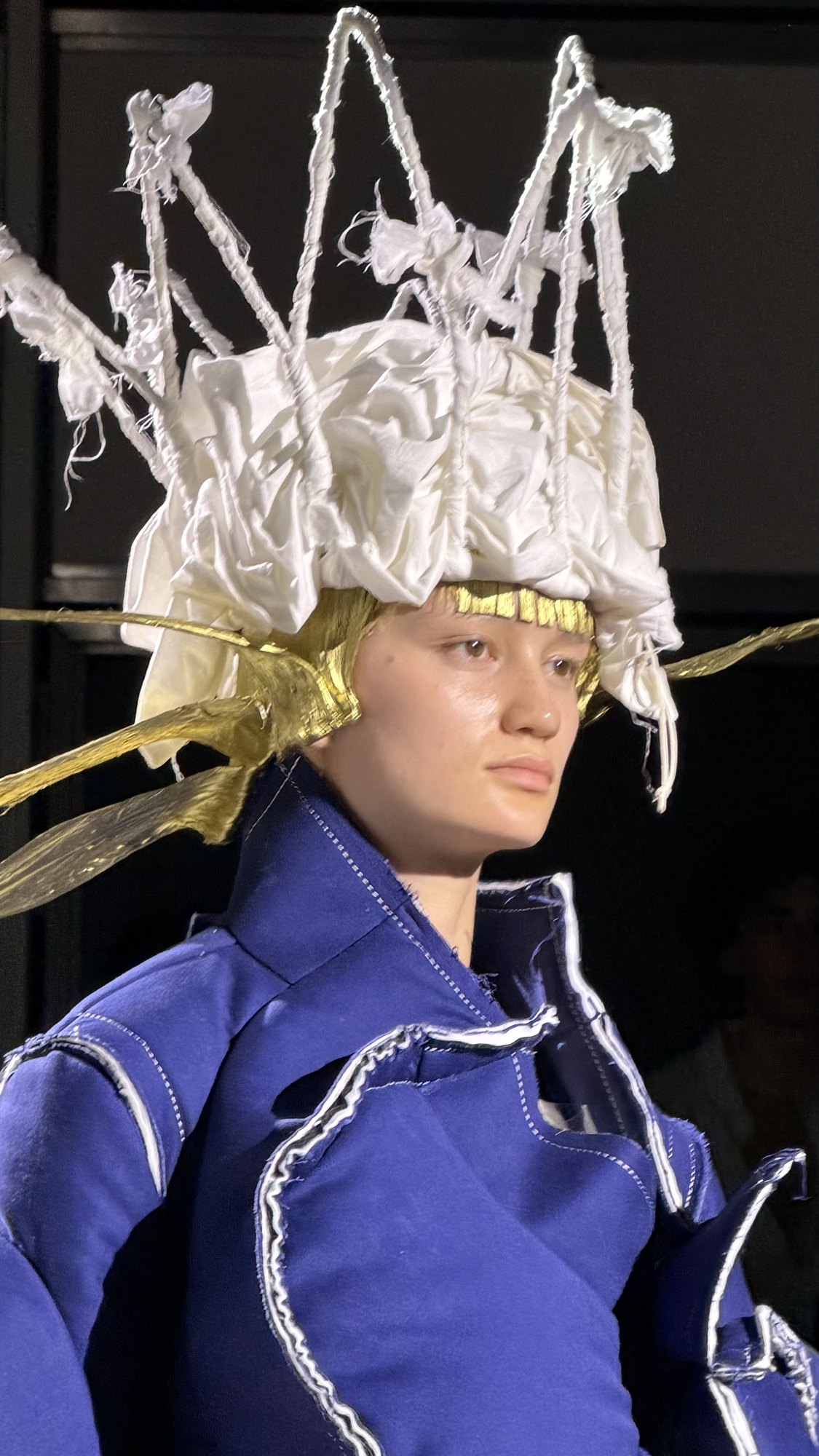
Denim ran through the collection from there, raw and rough cut, railroad striped, pinstriped, alongside cotton gabardine. And denim was not the only plain fabric she gave the royal treatment. The vocabulary of the collection was assembled almost entirely from the fabrics of ordinary working life, then inflated, embellished with gold braiding and passementerie, and carried as ceremony.
This is what her one sentence actually describes. Not a meeting between two worlds, but a single world in which the distinction has already dissolved. Royal life and everyday life did not collide somewhere in the middle of the show. They were fused in the first look.
Below the crowns, the garments were equally resistant to ordinary proportion. Bodies disappeared inside volume. Fabric accumulated into bulging forms that read as a snowman, a violin, a guitar. Trench coats, bombers, and puffers were still discernible inside the swelling. The models were not simply wearing these clothes. They seemed to be carrying them.
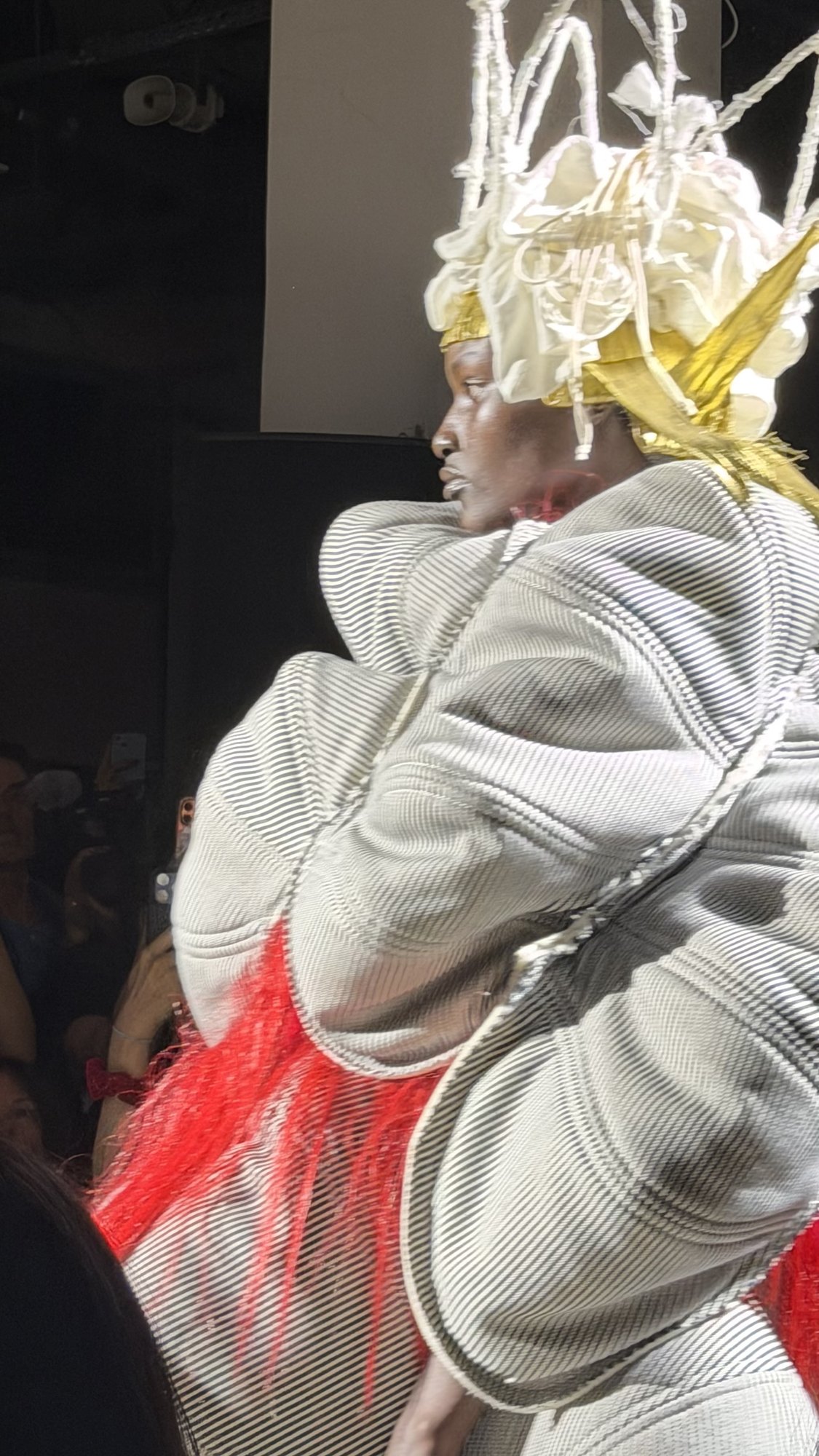
That distinction has become central to Kawakubo’s work. Clothing conventionally begins with the body and asks what can be placed upon it. Comme des Garçons seems to begin elsewhere, with an idea, a volume, a problem, and then asks the body to negotiate its way through. Here the scale changed how each figure occupied space, and the slow pacing gave every one of them time to arrive as an object in its own right before meeting the next.
Then the structure of the show changed. After a long procession of single figures spaced well apart, the final four looks came out as a group, one close behind the next.
The clothing concentrated rather than changed: supersized denim shorts, barrel pants, and wide-legged jeans, cuffs dragging along the floor. Denim had been there from the beginning. Here it was all there was.
And the crowns did not disappear. They changed material. The padded white constructions gave way to something gold that caught the light like foil, closer to hair or a helmet than a cloud. All of it gold. From where we sat, it did not read as the absence of a crown. It read as a crown that had stopped pretending to be fabric.
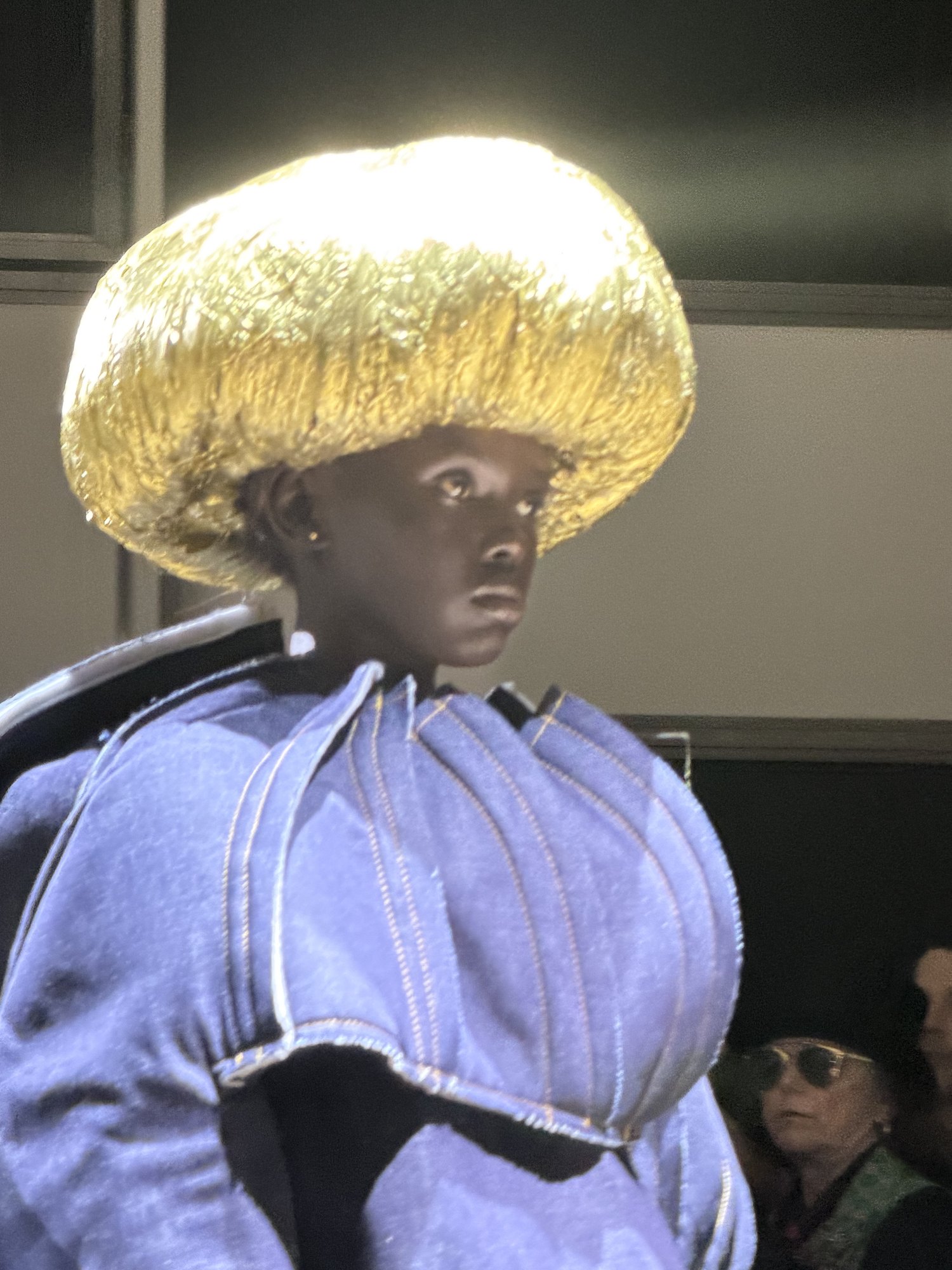
It would be too simple to say that the first part of the show was royalty and the last four looks were reality. Kawakubo’s work rarely rewards that kind of certainty, and there is no reason to force a single interpretation onto it. But she did not illustrate the distance between royal life and everyday life. She removed it. The most ordinary material in modern dress wore the crown from the first look to the last, and by the end the crown itself had turned to gold.
What stays with us is the conviction it takes to make that argument at all. Denim, gabardine, and a pinstripe are what most people already own. Kawakubo’s claim is that none of it sits beneath ceremony, and that the line between what we wear to be seen and what we wear to live is an agreement rather than a fact. On a long, slow, turning runway in Paris, she withdrew from the agreement, and left us to notice that we had been keeping it.