There are runway shows that present clothes, and there are runway shows that construct a world around them. Notes from the Ann Demeulemeester Spring/Summer 2027 show at the Réfectoire des Cordeliers in Paris.

Ann Demeulemeester Spring/Summer 2027, Paris
There are runway shows that present clothes, and there are runway shows that construct a world around them.
Ann Demeulemeester’s Spring/Summer 2027 collection belonged decisively to the latter.
Stefano Gallici called it Lonesome Heaven, a title that already contains something of the tension running through the collection: romance and isolation, beauty and deterioration, the freedom of the open road and the strange loneliness that comes with it.
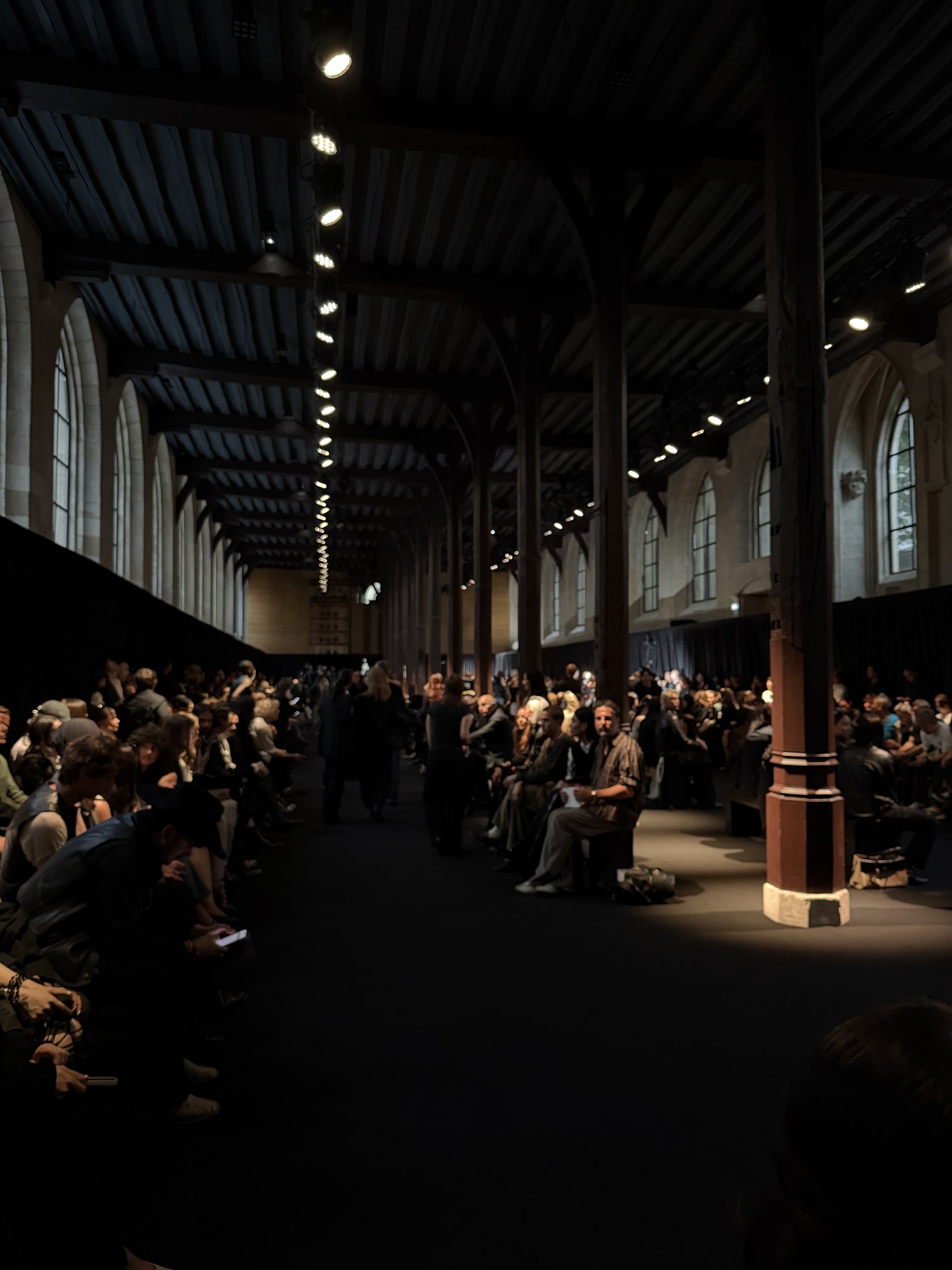
It was shown in Paris on October 3 at the Réfectoire des Cordeliers, the former convent hall that was Ann Demeulemeester’s own chosen venue for years before she stepped away from the house in 2013. Gallici brought his particular vision of the American West into one of the most historically charged spaces the house has.
That contrast mattered.
The Cordeliers is austere and enclosed, with the atmosphere of a place built around withdrawal. Gallici’s reference point, by contrast, was the vast openness of the California desert.
The collection began for him on the road.
He has described driving alone through the desert near Palm Springs on his way back toward Los Angeles with Kyuss’s Welcome to Sky Valley playing. In that landscape, he said, life seemed to reduce itself to essentials. The collection grew out of that experience: emptiness, road, music, dust, distance.
That story makes particular sense to us because Gallici’s interest in the American landscape is not something invented for a season.
Over the past year we have spoken with him more than once about his fascination with the West — with highways, small towns, roadside culture, vintage clothing, and the visual language that accumulates around travel.
This summer he drove from Atlanta to Los Angeles, making his way across the country and deliberately stopping to look.
Santa Fe was one of those stops.
He stayed outside the city in Chimayó and spent a considerable part of his time doing exactly what a good designer probably should do on a road trip: disappearing into vintage stores, thrift shops, and secondhand shops, looking closely at things that had already lived a life.
We had expected to spend somewhat more time together while he was here. Instead his schedule kept expanding as he found another place he wanted to visit, another shop he wanted to investigate, another object or garment that had caught his attention.
At the time it seemed like curiosity.
Seen through Lonesome Heaven, it looks more like research.
That distinction is important because the collection did not feel like a designer arriving in America, collecting a few Western references and converting them into fashion.
It felt lived in.
The clothes themselves appeared to have lived lives as well.
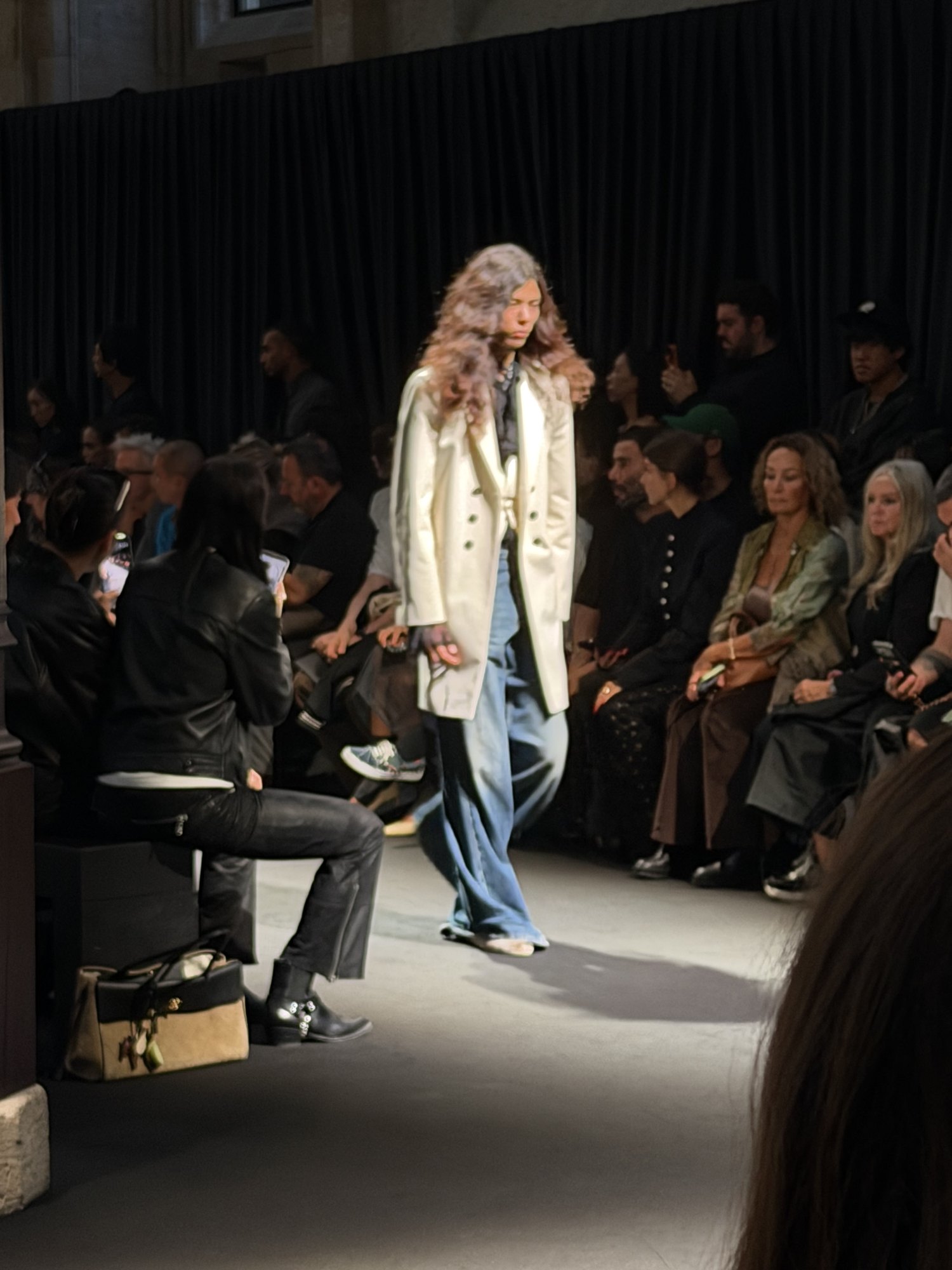
The palette initially stayed close to white, cream, and ecru before moving toward black and faded denim. Fabrics appeared worn, stained, repaired, abraded, and aged. Tailoring looked as though time had passed through it. Leather carried patina. Denim appeared torn and reconstructed. Formal pieces were treated in ways that made them feel inherited rather than newly manufactured.
That sense of deterioration was never merely decorative.
It gave the collection memory.
Ann Demeulemeester has never been a house whose identity rests on minimal basics. It has always had an unusually specific and immediately recognizable vocabulary: romantic tailoring, historical silhouettes, sheer fabrics, leather, high collars, elongated proportions, ribbons, feathers, asymmetry, and a constant negotiation between masculine and feminine.
There is a lot going on.
There always has been.
The sharpest early criticism of this collection went straight at that. Writing in the Italian title Whoopsee the day of the show, Sara Van Bussel located Gallici’s difficulty less in his understanding of the house’s language than in his measure of it: bring every code to the surface at once, she argued, and a complex language flattens into a repertoire of immediately recognizable signs. Her verdict was that the whole remained too heavily loaded.
That observation is not entirely wrong.
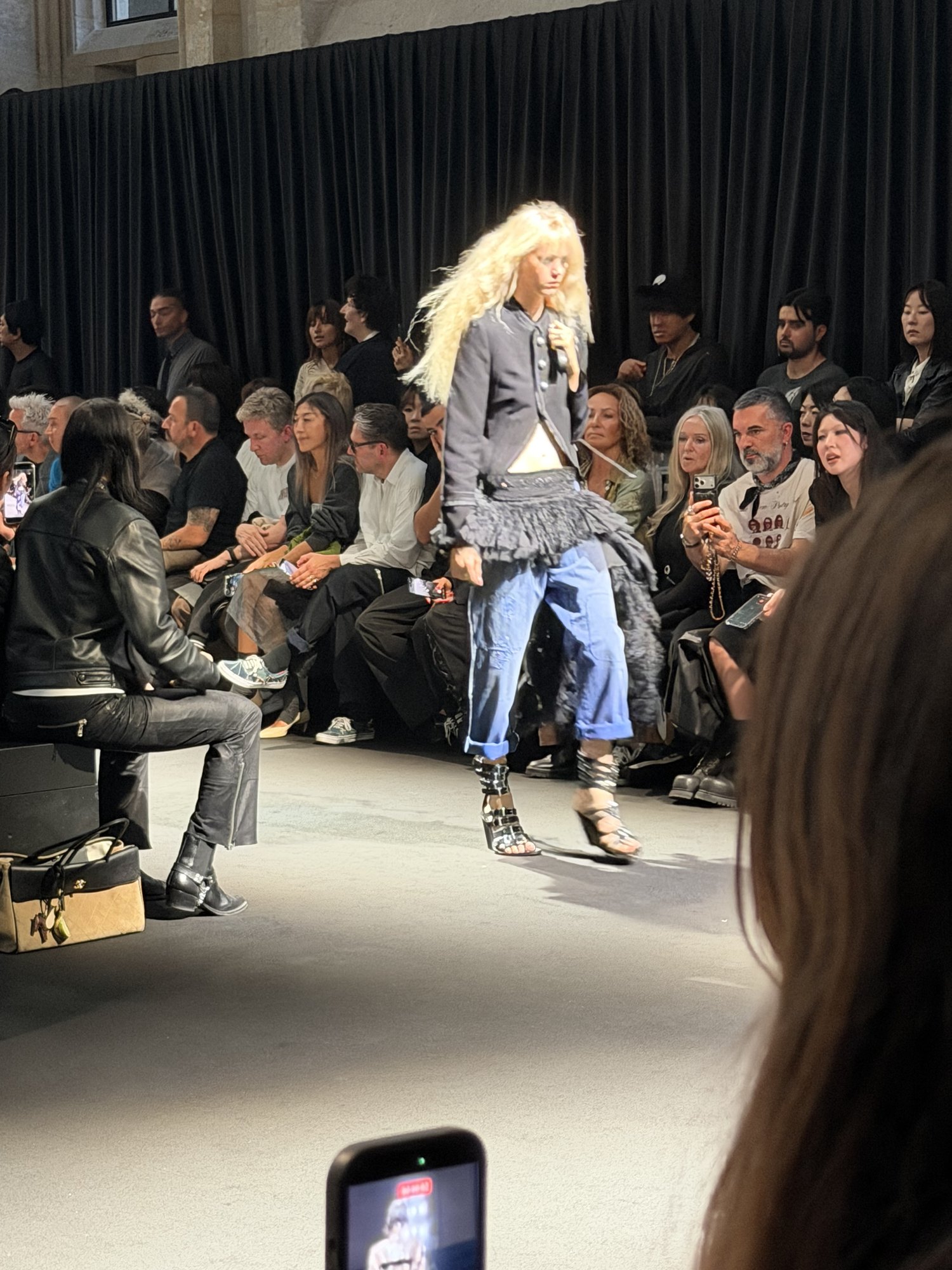
There were looks here that were emphatically styled. Layers accumulated. Collars rose high. Fabric trailed. Fringe, leather, tailoring, sheer material, and historical references could coexist within a single silhouette.
But that is also one of the reasons the show worked.
A runway does not necessarily need to demonstrate the literal way someone will walk out of a store dressed on Tuesday afternoon.
At its best, a runway show exaggerates.
It builds an atmosphere large enough for individual garments to exist inside it.
Those garments will eventually be separated. A jacket will be worn with jeans. A sheer shirt will be worn without the three other layers that surrounded it on the runway. A pair of trousers will migrate from a convent in Paris into somebody’s ordinary life.
But before that happens, the designer has an opportunity to show the entire imagined world at once.
Gallici took it.
The world of Lonesome Heaven was not communicated only through clothing.
Chelsea Wolfe performed live.
Her presence immediately changed the relationship between the collection and its soundtrack. Music was not being added afterward to create drama around the clothes. It was physically in the room, inhabiting the same space as the models.
Then there was Josh Homme.
Homme walked the runway in pinstripe tailoring and a light denim shirt, but his inclusion carried more meaning than the standard musician-as-model fashion cameo.
Before Queens of the Stone Age, Homme was the guitarist in Kyuss — the very band whose Welcome to Sky Valley Gallici had been playing during the desert drive that helped generate the collection.
To have Homme physically enter the show completed the circle between the landscape, the music, and the clothes.
At the other end of the collection was Ethel Cain.
Cain closed the show in an Edwardian-influenced black Chantilly lace dress with a tightly defined waist, a look she developed with Gallici. A capsule she designed with the house reached the new Paris boutique days later.
Her inclusion made equal sense.
Cain’s own artistic world is built around a darker American mythology — religion, rural landscapes, isolation, romantic decay, and the tension between beauty and menace. In the context of Lonesome Heaven, she did not feel imported into the collection.
She already seemed to live there.
Casting, in fact, was one of the ways the show’s larger community became visible.
Our colleague Lucia Richardson walked in the collection as well, which gave the experience a small but meaningful personal connection for us. Her presence among the cast was another reminder that these shows are never quite as distant from our own working world as they can sometimes appear from the outside.
The audience carried that same mixture of fashion, film, and music, with figures including Ann Demeulemeester herself alongside actors, models, and musicians.
Ann’s presence deserves more than a passing mention.
She has now been away from the creative direction of the house for years. Gallici is not designing under her supervision, and the current version of the brand does not pretend that she is still directing it from somewhere behind the curtain.
And yet she remains present.
We had seen her only days earlier at the opening of the new Paris boutique at the Palais-Royal, and there she was again at the runway show, sitting in the audience as Gallici presented an increasingly personal interpretation of the company that still carries her name.
Gallici has said that he is in touch with her weekly and has called her his unfiltered counselor, which is an unusual way to hold a house you no longer run. It appears to work because Ann is present without hovering. She can remain a witness to the evolution of the house without requiring it to stay frozen at the moment she left it.
That becomes particularly interesting with a collection like this one, because Lonesome Heaven feels increasingly like Stefano Gallici rather than simply Stefano Gallici doing Ann Demeulemeester.
The house codes are still visible everywhere.
The high collars are there.
The romantic tailoring is there.
The historical references are there.
The tension between fragility and severity is there.
But they are being filtered through things that belong specifically to him: California, road travel, desert rock, Los Angeles, vintage Americana, objects found while moving through unfamiliar places.
On this evidence his real strength is synthesis — the ability to take inherited references and make them autobiographical rather than nostalgic. That is harder than either preservation or rupture, and it is the thing almost nobody who inherits a house manages.
So the interesting question is no longer whether he understands the vocabulary of Ann Demeulemeester.
He clearly does.
The more interesting question is what he can make from it once he stops treating that vocabulary as something that needs to be preserved intact.
Lonesome Heaven offered one answer.
The collection was romantic, but not nostalgic. It was historical without feeling like a costume exercise. It was maximal without becoming indiscriminate. And although much of its emotional imagery belonged to the American West, it never tipped into a straightforward Western collection.
There were no easy cowboys here.
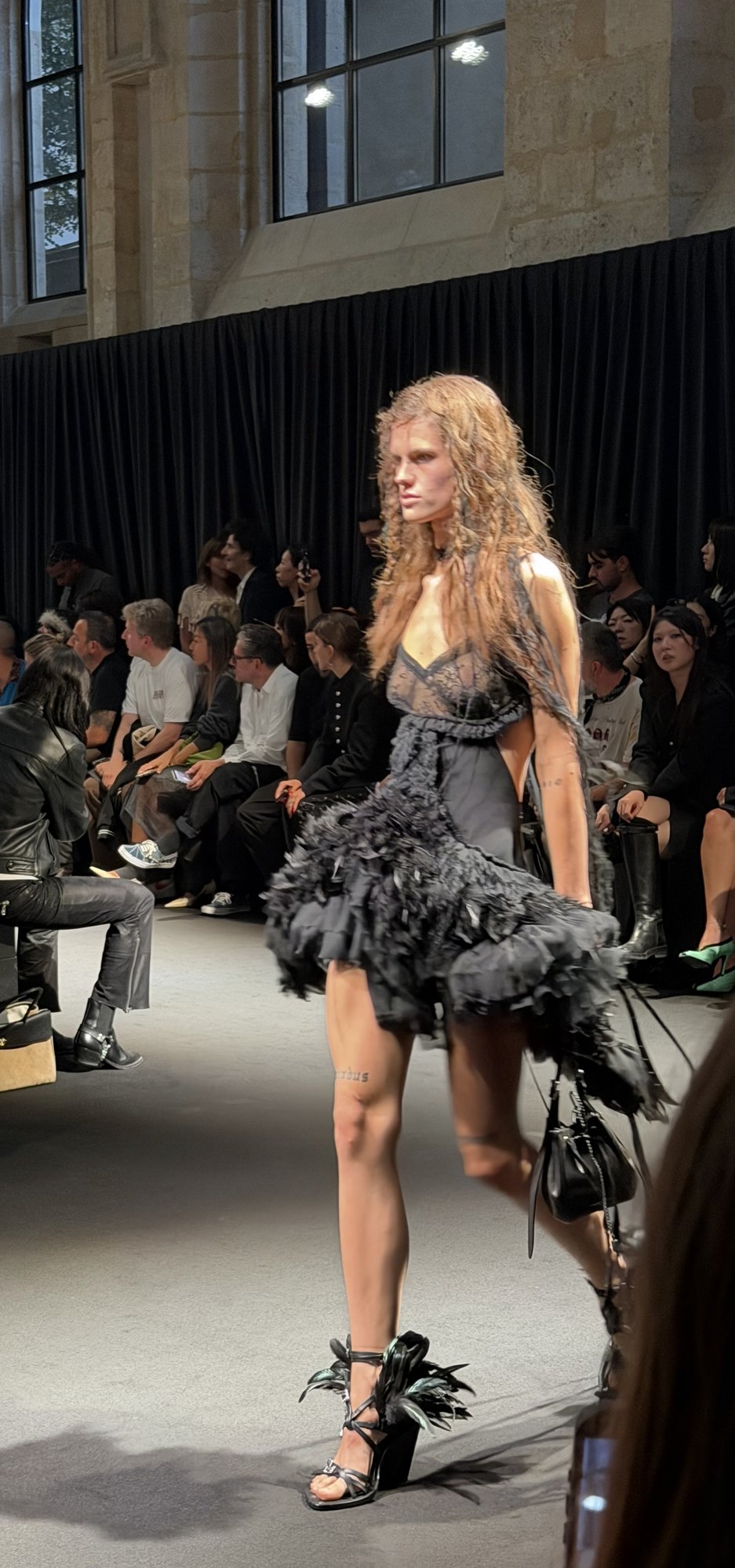
The desert appeared instead through erosion, solitude, clothing damaged by time, and the strange beauty of things that have survived long enough to become more interesting.
The former convent held all of it. By the time the last look disappeared, the collection felt less like a sequence of references than an inhabited place.
We have attended and written about many Comme des Garçons and Rick Owens shows over the years. Those houses have naturally occupied a considerable amount of space in our Paris coverage because they consistently offer something larger than seasonal merchandise.
We have not historically given an Ann Demeulemeester runway the same kind of standalone attention.
This season changes that.
There is something happening at the house that feels worth following closely.
Not because Gallici is abandoning what Ann created.
And not because he is reproducing it perfectly.
Because he seems increasingly comfortable doing the more difficult thing:
taking possession of it.
The house remains recognizable. The language remains intact. But somewhere between Antwerp and Los Angeles, between the Cordeliers and the California desert, it has begun to acquire another accent.
And Lonesome Heaven may be the clearest expression of it yet.